
What is Orangeburg sewer pipe and how did it enter Colorado homes?
Orangeburg pipe—technically classified in plumbing engineering as "bituminous fiber pipe"—is one of the most problematic building materials remaining beneath mid-century Colorado residences. Named after its primary manufacturer, the Orangeburg Fibre Conduit Company of Orangeburg, New York, the material was fabricated from wood cellulose fibers compressed into cylindrical tubes and vacuum-impregnated with liquefied coal-tar pitch. Originally developed in the late 19th century as protective electrical conduit, bituminous fiber was repurposed as residential sewer and drain piping during World War II due to severe wartime metal shortages. During the post-war suburban building boom from 1945 through the late 1960s, builders across Wheat Ridge, Littleton, Englewood, Applewood, and Lakewood embraced Orangeburg as an inexpensive, lightweight, and easy-to-cut alternative to heavy cast iron and brittle vitrified clay. Promoted as having a 50-year design life, it was installed beneath thousands of residential subdivisions across the Denver metropolitan basin.
The four-stage failure mechanics of bituminous fiber piping
While cast iron rusts and vitrified clay cracks under soil shear, Orangeburg pipe fails through a progressive, irreversible structural breakdown that ultimately ends in total subterranean collapse:
1. Moisture absorption and internal delamination
Constant exposure to household wastewater causes the compressed paper cellulose to absorb water over decades. As moisture penetrates, the coal-tar pitch bond degrades, causing the compressed layers to unroll and separate—a structural failure known as delamination. The pipe walls soften into a consistency resembling wet cardboard.
2. Ovalization and cross-sectional deformation
Unlike rigid clay or Schedule 40 PVC, softened bituminous fiber has virtually zero compressive beam strength. Under the heavy overburden pressure of six to eight feet of dense Front Range clay soil, the circular pipe begins to deform, flattening into an oval or egg shape and reducing hydraulic flow capacity by more than 50%.
3. Internal blistering, corrugation, and paper dams
As delamination accelerates, internal fiber layers bubble inward, creating jagged corrugations along the pipe invert (bottom) and crown (top). These fibrous blisters act like barbed hooks, snagging toilet paper, grease, and hair, creating chronic, inexplicable drain stoppages.
4. Complete structural pancake collapse
In the final stage of failure, external soil pressure completely crushes the softened pipe walls together. The pipe "pancakes" shut, stopping all sewage flow and forcing wastewater directly back into home basement fixtures.
Clear warning signs your Front Range home has Orangeburg pipe
Because Orangeburg pipe is buried underground, homeowners rarely discover its presence until an emergency occurs. However, several distinct physical symptoms indicate that your lateral is composed of failing bituminous fiber:
Home construction date between 1945 and 1972
If your residence was constructed during the post-WWII boom—especially in subdivisions built across Wheat Ridge, Lakewood, Englewood, or southern Littleton—there is a high statistical probability that original builder drainage used bituminous fiber.
Frequent mainline clogs that standard snaking fails to cure
If you pay a drain technician to clear your sewer line and drains slow down again within several weeks, the pipe has likely ovalized. Standard mechanical snake blades simply push through a narrow slit without restoring a circular diameter.
Plumbing snake punch-throughs during cleanout attempts
One of the most definitive indicators occurs when a plumber runs a mechanical auger into the line and the heavy steel blade punches straight through the soft fiber pipe wall into surrounding soil, pulling back black wood pulp fibers and mud rather than toilet paper.
Spongy yard depressions and localized sinkholes
As the softened pipe wall disintegrates, raw sewage saturates the yard from below, creating localized sunken patches of dark, foul-smelling lawn above the sewer lateral trench.
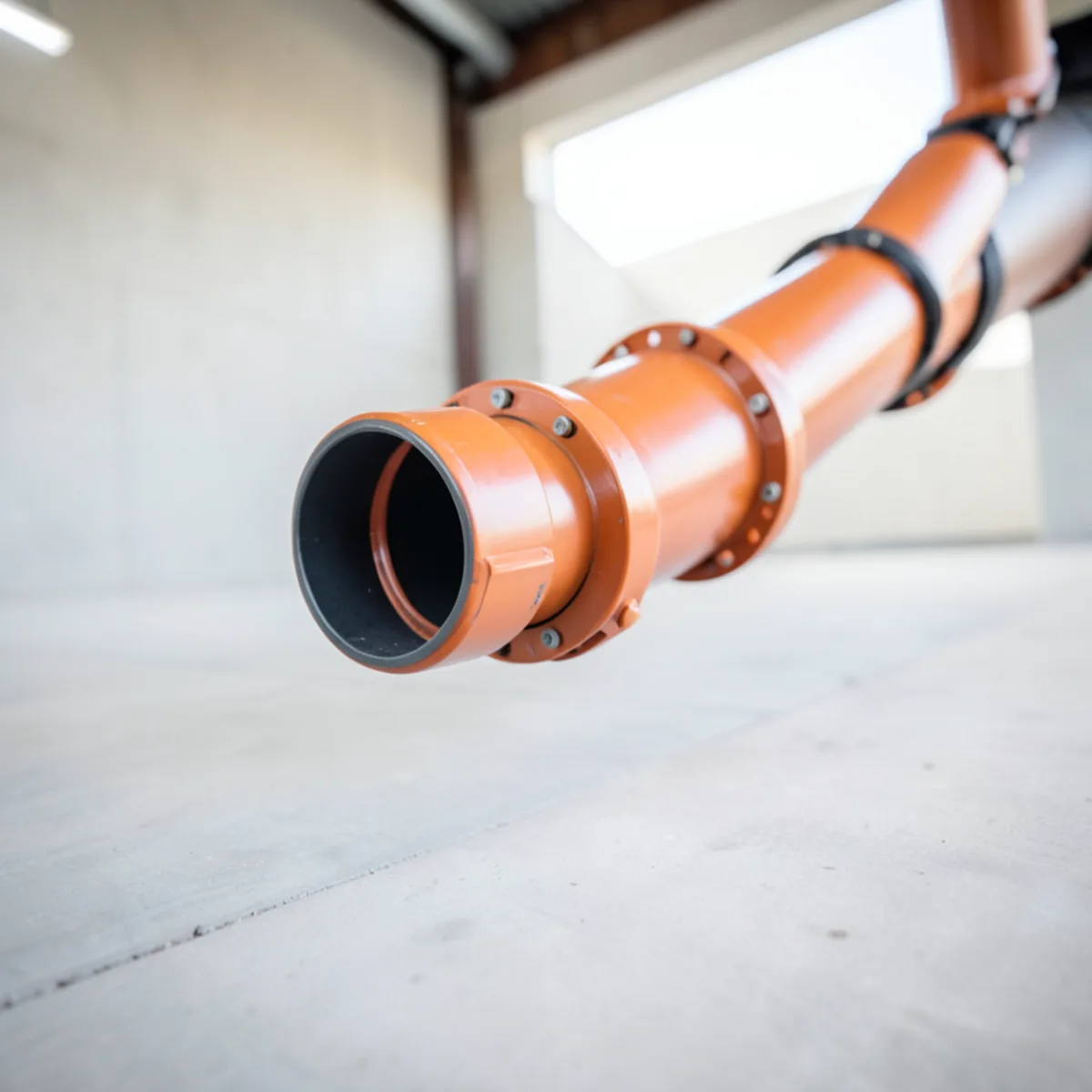
Why Orangeburg pipe cannot be repaired or lined with CIPP
Homeowners frequently ask if their failing Orangeburg pipe can be rehabilitated using Cured-in-Place Pipe (CIPP) epoxy lining to avoid excavation. In the professional plumbing community, attempting to line Orangeburg pipe violates ASTM F1216 engineering standards. CIPP inversion lining requires a structurally sound, circular host pipe to support the resin-saturated felt tube while it cures under hot water or steam pressure. Because Orangeburg pipe is almost always ovalized, blistered, or partially collapsed, the inflatable liner cannot conform uniformly, resulting in massive resin wrinkles, unbonded voids, and immediate re-collapse. Any contractor offering to line an Orangeburg pipe is selling a temporary, non-warrantied fix that will fail within months.
Permanent replacement solutions: trenchless pipe bursting vs. open-cut excavation
The only code-compliant, permanent solution for failing Orangeburg pipe is complete physical replacement with Schedule 40 PVC or SDR 17 High-Density Polyethylene (HDPE). If the Orangeburg line is discovered before total pancake collapse—meaning an optical camera push cable or pulling wire can still pass through the channel—trenchless static pipe bursting is the ideal method. Our crews excavate two small access pits at either end of the lateral. A high-tonnage hydraulic bursting unit pulls a hardened steel expander head through the fragile fiber pipe, shattering the brittle coal-tar remnants outward into the surrounding soil while simultaneously drawing a seamless, continuous, joint-free SDR 17 HDPE pipe into place in a single day.
Municipal plumbing code requirements in Wheat Ridge and Lakewood
Under plumbing codes enforced by the City of Wheat Ridge Building Division, Wheat Ridge Sanitation District, and City of Lakewood, spot repairs on Orangeburg pipe are explicitly prohibited. Because adjacent sections of fiber pipe are already structurally compromised, splicing a new plastic section into old fiber with rubber Fernco bands causes immediate failure at the transition. Municipal rules mandate complete lateral replacement from the foundation wall to the city collection main, accompanied by mandatory dual-directional cleanouts and approved compaction testing.
Bedding and slope verification for open-trench replacement
When an Orangeburg line has completely pancaked shut and cannot pass a pulling wire, targeted excavation is required. The collapsed fiber line must be fully extracted, and the new Schedule 40 PVC pipe must be laid on a continuous bed of washed 3/4-inch crushed squeegee gravel to guarantee a permanent 1/4-inch per foot slope that will not settle in Front Range clay soils.