
The widespread misconception surrounding public sewer billing
Nearly every homeowner in Littleton, Englewood, Denver, and surrounding Front Range communities receives a regular sewer utility bill from their municipality or special sanitation district. Because these bills arrive quarterly or monthly alongside water or property tax assessments, many property owners assume that the public utility oversees the entire underground wastewater infrastructure leading away from their home. The common assumption is: "I own the plumbing inside my house, and the city owns the pipe once it leaves my foundation wall." Unfortunately, under Colorado municipal law and sanitation district rules, this assumption is completely false. In virtually every Colorado jurisdiction, the private property owner owns and is exclusively liable for the entire underground sewer service lateral, beginning at the exterior foundation wall and extending across private property, beneath public sidewalks, under street curbs, all the way to and including the physical connection at the municipal collector main in the middle of the street.
Defining the legal boundaries: private service lateral vs. public collector main
To understand who pays when a sewer line collapses or clogs, wastewater engineering frameworks divide urban drainage networks into two distinct categories:
1. The public sewer collection main
The public sewer main is a large-diameter pipe (typically 8 inches to 36 inches in diameter) running horizontally beneath the center of public streets, alleys, or dedicated municipal utility easements. This line is owned, operated, and maintained by the municipality or special sanitation district. It collects combined wastewater from dozens or hundreds of residential laterals and conveys it to regional treatment facilities, such as Metro Water Recovery or the Englewood/Littleton Wastewater Treatment Plant.
2. The private residential sewer service lateral
The private service lateral is the single 4-inch or 6-inch pipe that channels sewage from your home plumbing system out to the public main. Under municipal codes across the Denver metro—including Littleton City Code Title 7, Chapter 2—the property owner owns the entire length of this pipe. The homeowner is legally obligated to clear all clogs, remove invasive tree roots, repair structural cracks, and replace collapsed sections, even when those defects sit completely outside your property boundary underneath the public roadway.
The tap connection debate: who owns the street tie-in and saddle?
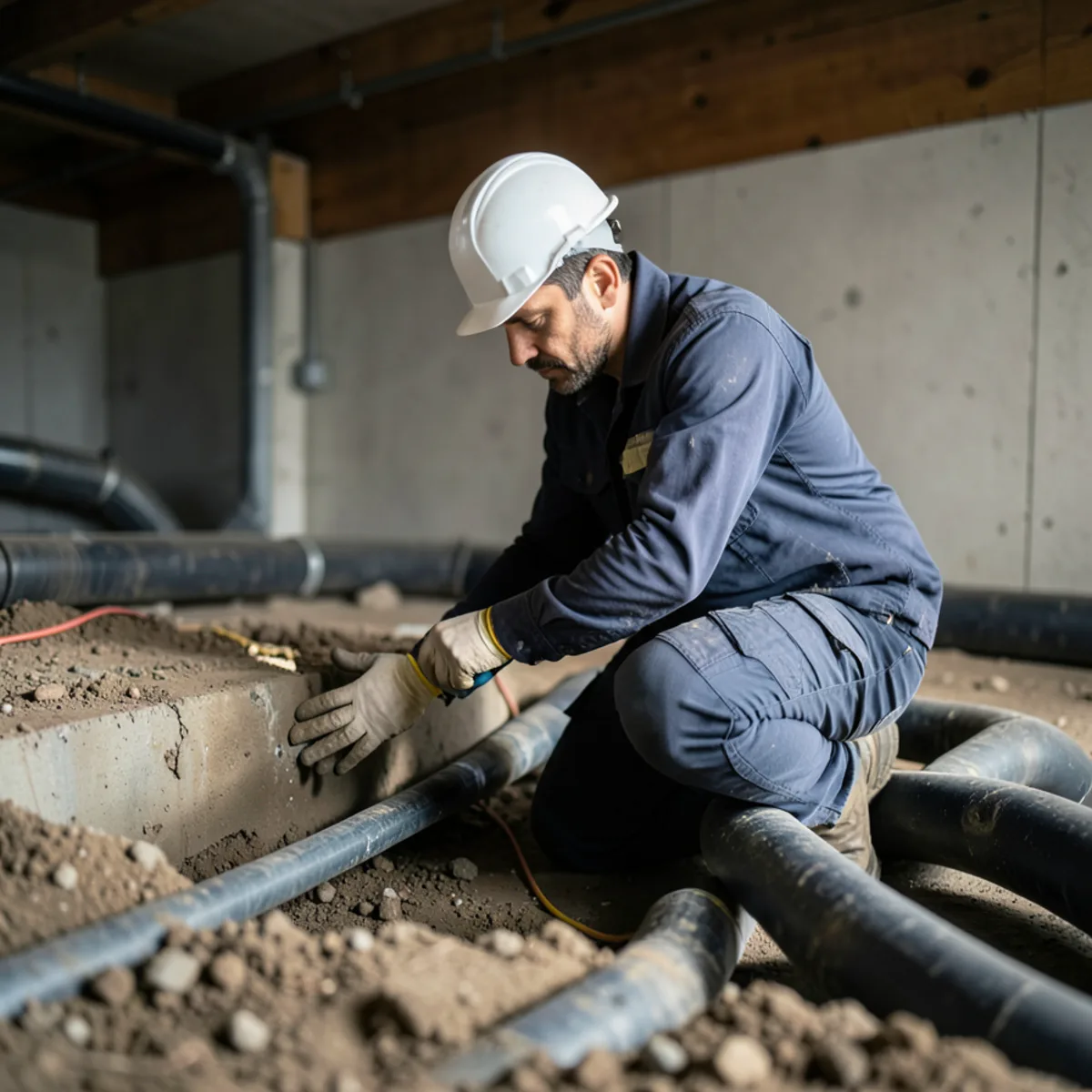
One of the most alarming revelations for homeowners facing an off-property sewer failure is the tap connection rule. When your sewer lateral reaches the city sewer main under the center of the asphalt street, it connects via an engineered saddle, wye, or inserted tee fitting. In the City of Littleton, City and County of Denver (DOTI), City of Englewood, and across unincorporated Arapahoe and Douglas Counties, municipal codes explicitly dictate that the homeowner owns the tap connection itself. If the saddle cracks, if the connection slips, or if an offset develops at the exact municipal junction, the homeowner is legally and financially responsible for executing the repair. Because this work occurs within the public right-of-way, homeowners cannot simply dig up the street; they must contract an insured, licensed master plumber authorized to perform certified right-of-way excavations.
Navigating municipal right-of-way permits, traffic staging, and street cut bonds
When an underground sewer lateral fails beneath a public street or sidewalk, repair costs increase dramatically due to municipal right-of-way (ROW) compliance mandates. Unlike excavating on private property, executing an excavation within a public roadway requires a series of strict administrative and engineering steps:
Municipal right-of-way permits and licensing
Contractors must hold active municipal licenses, maintain substantial general liability insurance, and post surety performance bonds (often $10,000 to $25,000) with the city public works department before receiving an excavation permit.
Engineered traffic control and road safety staging
City engineering divisions mandate approved traffic control plans conforming to the Manual on Uniform Traffic Control Devices (MUTCD). This requires certified flaggers, directional arrow boards, and construction barricades to safely divert vehicular and pedestrian traffic.
Steel road plating and structural backfill standards
Open trenches in active traffic lanes must be covered with heavy-duty pinned steel road plates during non-working hours. When backfilling, municipalities prohibit using native clay soils; contractors must import structural CDOT Class 6 aggregate or flowable cementitious slurry backfill, followed by certified nuclear density compaction testing.
Hot-mix asphalt restoration and pavement warranties
The contractor must execute an engineered T-cut of the surrounding asphalt, apply hot-mix asphalt in compacted lifts, infrared seal the seam, and provide a 1-to-2-year formal pavement settlement warranty to the city.
Front Range special sanitation district matrix
The Denver metropolitan area is unique in that wastewater utility service is divided among hundreds of quasi-municipal special districts rather than a single unified provider. In the Littleton area alone, properties may fall under the City of Littleton Public Works, Southgate Sanitation District, Platte Canyon Water and Sanitation District, Southwest Metropolitan Water and Sanitation District, or Valley Sanitation District. While administrative procedures and permit fees vary between districts, every single special district in the region enforces the same core standard: 100% private homeowner lateral responsibility from the building wall to the collector main connection.
Littleton and Southgate permit and inspection protocols
Under Littleton City Code Title 7, Chapter 2, any excavation impacting the public sewer system requires an individual connection permit, licensed plumbing oversight, and an on-site visual inspection by city engineering staff before backfill. Similarly, Southgate Sanitation District mandates certified air testing or mandrel deflection testing for newly installed lines, alongside strict contractor bonding.
Platte Canyon and Valley Sanitation tap connection requirements
Districts like Platte Canyon and Valley Sanitation require specialized Inserta-Tee or tapping saddles approved by district engineering specifications. If an existing tap connection has cracked or displaced, the district mandates that a licensed contractor excavate the municipal main, cut out the damaged section, and install an approved PVC or ductile iron wye fitting under formal district supervision.
How to protect yourself with service line insurance endorsements
Because standard homeowners insurance policies (HO-3 and HO-5) exclude underground utility lines damaged by normal wear, root intrusion, and ground settling, homeowners face major out-of-pocket exposure. Fortunately, most major insurance carriers now offer an inexpensive "Buried Utility Service Line" or "Service Line Protection" endorsement. For an annual premium of approximately $30 to $60, these endorsements provide $10,000 to $20,000 in coverage for underground sewer lateral replacements, excavation costs, and public street restoration, with modest $500 deductibles. Every Colorado homeowner should verify whether their policy includes this vital protection.